Unburdened to Unavoidable: A Sentiment Analysis of the BMW M3
Building a Legend, and Living With It
The BMW M3 occupies a strange position in automotive culture. It is spoken about less as a car than as a lineage; a series of aspirations and grievances layered on top of one another over four decades. Each new generation is born burdened not just with performance targets, but with a set of expectations: of what the M3 once was, what it represented, and what it lost.
This article began as an attempt to separate in-period perception from rose-tinted memory. Rather than re-litigate the M3 through spec sheets or lap times, I wanted to understand how experienced journalists responded to each car when it was new—what they praised, what they questioned, and what they took for granted. Not to rank generations, but to trace how expectations themselves have shifted.
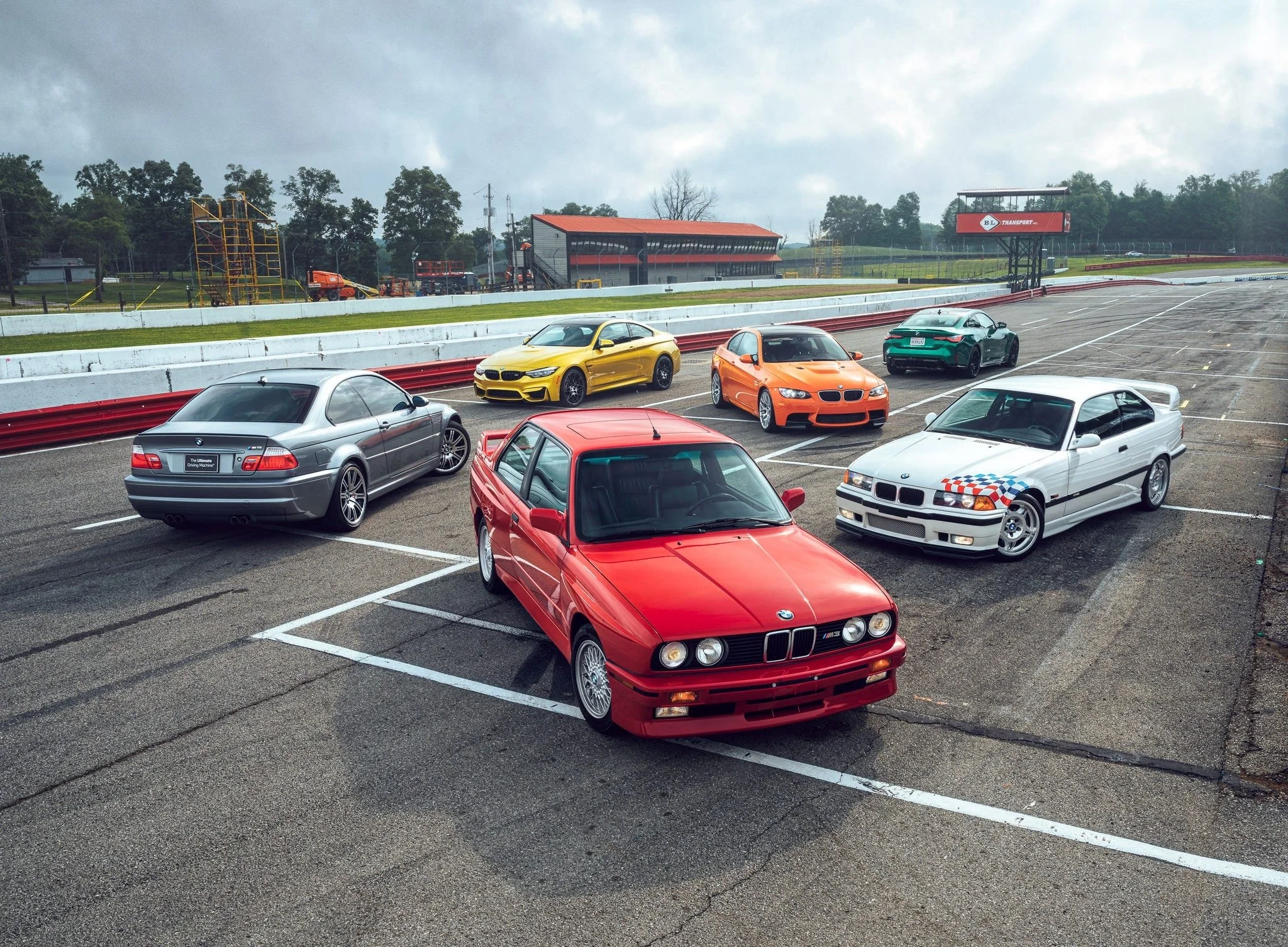
To do that, I turned to sentiment analysis (aka natural language processing). I analyzed six launch reviews from Car and Driver, one for each M3 generation, breaking each article down across consistent dimensions: driving feel, steering, balance, power, transmission, technology, design, and emotional character. Using the OpenAI API, each review was evaluated for confidence-weighted sentiment in those categories.
The goal wasn’t to produce a definitive scorecard. It was to surface patterns, to see where praise clustered, where friction first appeared, and how the language around the M3 evolved as the car itself grew faster, heavier, more complex, and more capable. What follows is less a verdict than a conversation across generations: between what the M3 was, what it became, and what we still ask it to be.
Reading the M3 Through Its First Impressions
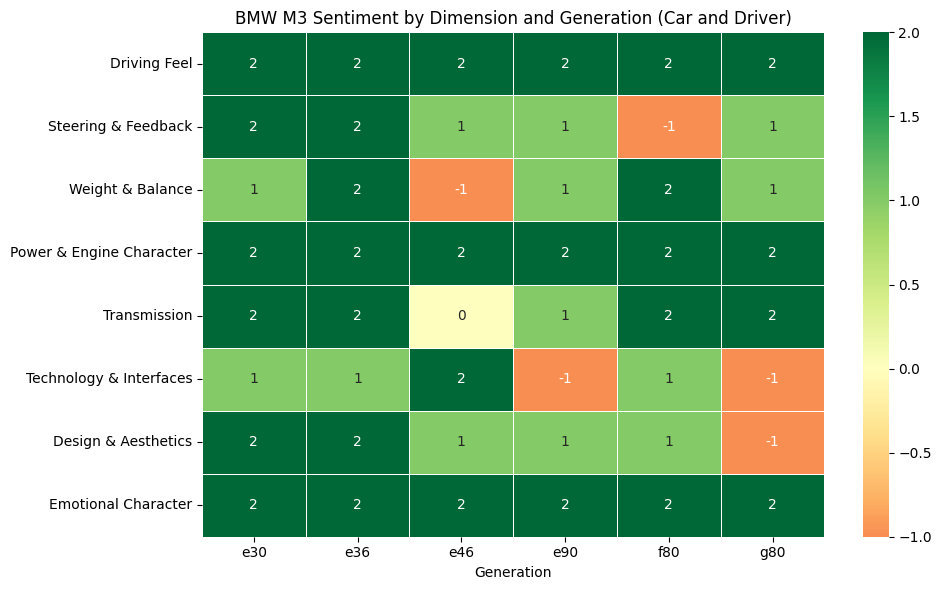
This heat map summarizes how Car and Driver writers responded to each BMW M3 at launch. A score of 2.0 indicates strong, unambiguous praise; 0.0 reflects neutrality or ambivalence. A 1.0 doesn’t signal disappointment so much as absence—a dimension that worked well enough not to demand comment. What critics linger on and what they pass over, tells us where a car felt settled and where it felt contested.
Read this way, the earliest M3s, the E30 (1988) and E36 (1995), stand out not because they excel in any single category, but because they provoke little resistance anywhere. Driving feel, steering, balance, power, and even design arrived without caveat. These cars weren’t yet negotiating their legacy; they showed up aligned with their moment, and the reviews reflect that ease.
The E46 (2001), often remembered as the canonical M3, is the first to introduce real friction. At its launch in Jerez, Spain, the car was set up to understeer at the limit. Likely as a safety measure against jamon-fisted drivers, yet ultimately frustrating experienced drivers who took it to the track. That behavior could be tuned out, but the moment matters and it shows up as a negative Weight & Balance score. Suspension harshness also enters the conversation. Meanwhile, steering feel and design settle into the background, not because they disappoint, but because they no longer surprise. They are assumed rather than celebrated.
With the E90 (2008), criticism shifts from setup to interface. This is the generation where technology becomes a character in the story—iDrive’s debut was widely disliked. The manual transmission draws familiar complaints about its rubbery feel. Power and emotional character remain strong, but the driver’s relationship to the car is now mediated by systems that demand explanation.
The F80 (2015) reflects an attempt to course-correct. Weight drops and balance is restored. While performance is unquestioned. Yet steering feel takes a clear hit with the move to electric assistance. The car remains thrilling, but the thrill now arrives around the interface rather than through it. Something essential has been traded, even as capability increases.
The G80 (2021) pushes this dynamic further. Power, grip, and emotional character score highly, but technology and especially design provoke renewed debate. The modern M3 is dense with features, modes, and layers. Yet, it asks for tolerance in exchange for breadth.
The Shape of the M3, Then and Now
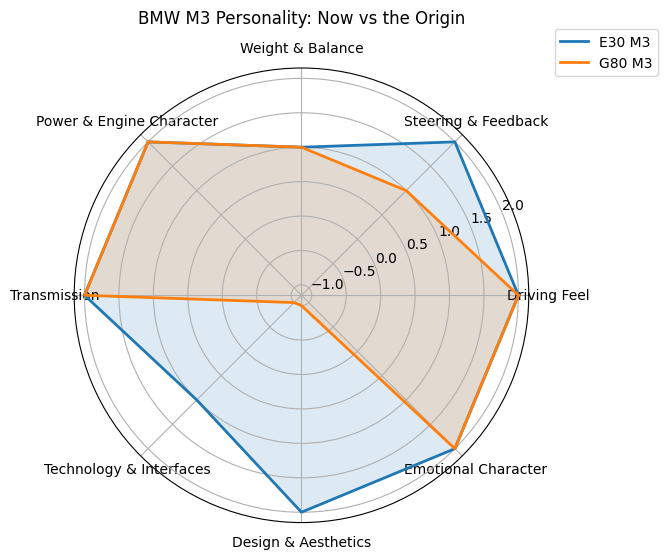
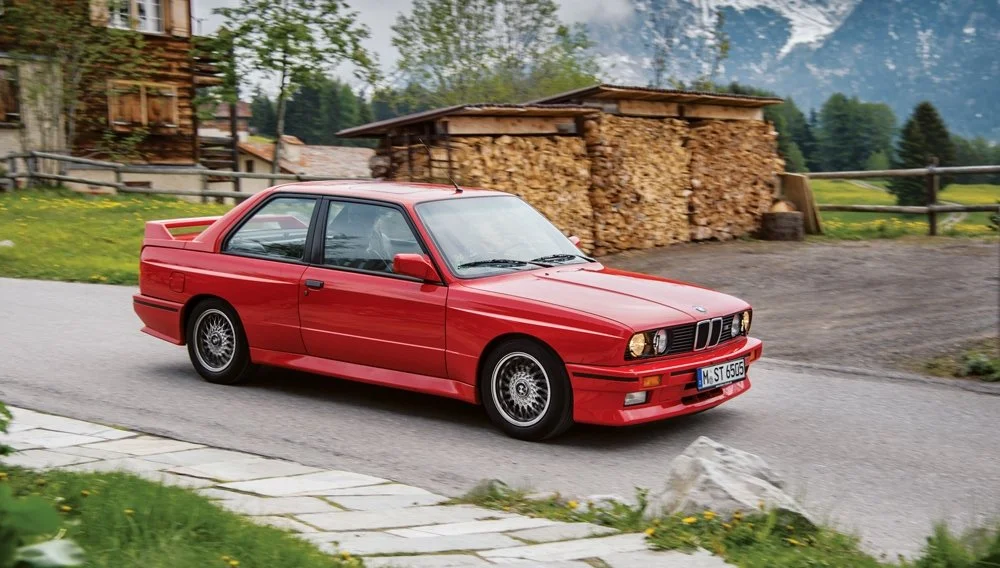
Seen side by side, the original E30 M3 and today’s G80 reveal something unexpected. The modern car hasn’t abandoned many of the traits that made the M3 matter in the first place. Driving feel remains strong. Emotional character is intact. Power and engine character are not just preserved but amplified. Whatever else has changed, the M3 still understands its role.
What has shifted is where that character lives. In the E30, personality is expressed directly: steering, balance, design, and interface form a singular experience. Nothing competes for attention and nothing needs justification.
The G80 carries that same intent through layers. Technology and interfaces now sit between driver and machine, sometimes enhancing the experience, sometimes negotiating it. Design no longer fades into the background; it asserts itself. The car’s strengths are undeniable, but they arrive bundled with modes, systems, and explanations.
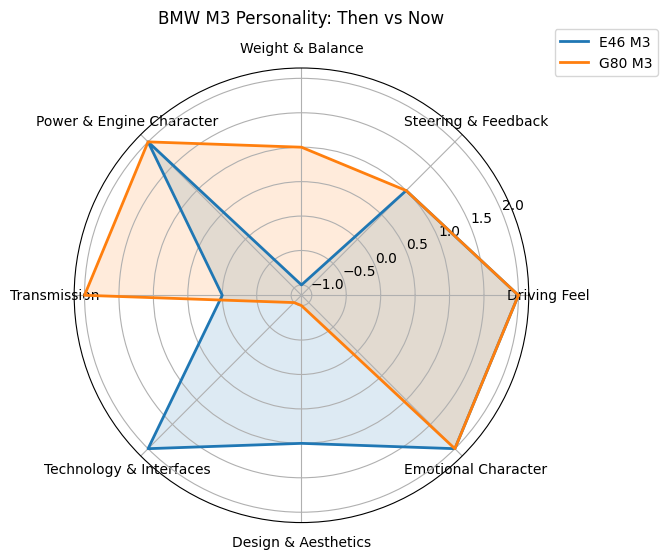
This shift becomes clearer when viewed through the E46, often remembered as the M3’s high-water mark. At launch, that car was criticized for understeer and it frustrated skilled drivers who expected neutrality at the limit. Today’s G80, by contrast, is so secure in its grip and electronics that it includes a built-in drift analyzer, not to prevent oversteer but to encourage and score it. The conversation has moved from managing push to measuring slip.
The transmission tells a quieter story. The E46’s manual earns little comment at launch because it was simply assumed. The G80’s manual, meanwhile, is praised not for tactility but for simply existing at all. What once went unremarked now feels worth celebrating.
What Endures, What Shifts, What We Still Ask For
Viewed together, the heat map and radar charts don’t tell a story of decline, but of accumulation. Over time, the M3 gained power, speed, and systems—and with them, layers of expectation, not to mention weight. Early cars are celebrated not because they were perfect, but because they were unburdened. Precise controls existed because they were necessary, not because they were configurable. Steering, balance, and feedback carried a quiet confidence, they didn’t need explainers. That purity is how the originals built the legend.
Qualities once assumed now feel precious. Features once criticized become nostalgic markers of restraint. Physical buttons—even redundant ones—read as merciful against today’s maddening touchscreens. The manual gearbox, once invisible, becomes something we’re grateful to still have at all. Not because it’s perfect, but because it represents a refusal to fully surrender to immediacy.
This is the quiet truth the exercise reveals: legends aren’t sustained by standing still, but neither are they sustained by endless addition. Each M3 generation inherits not just an engineering brief, but a cultural one, balancing progress against the risk of dilution. The M3 still provokes debate because it still attempts to answer the same question: how can we make driving matter?
Data Sources:
https://www.caranddriver.com/reviews/a15140693/1988-bmw-m3-road-test-review/
https://www.caranddriver.com/reviews/a15141488/1995-bmw-m3-road-test-review/
https://www.caranddriver.com/reviews/a15139599/2001-bmw-m3-first-drive-review/
https://www.caranddriver.com/reviews/a15147795/2008-bmw-m3-road-test/
https://www.caranddriver.com/reviews/a15109279/2015-bmw-m3-instrumented-test-review/
https://www.caranddriver.com/reviews/a35758226/2021-bmw-m3-drive/